27 May 2026
Your Charter of Hope is a simple way to bring together your community’s priorities and show what people want to see happen locally. It can be used to build visibility for your campaign and lay the groundwork for influencing your council.
We will cover how to use what you heard to engage councillors in a way that feels positive and rooted in your local priorities.
Use your listening campaign to engage councillors and help:
- show councillors what people in their area care about most
- keep conversations hopeful and focused on solutions
- empower people in your community to speak directly to local decision makers
- reach new audiences who may not usually get involved in campaigning
A quick summary of how to make a charter for hope:
- Bring together what you heard through your listening activities
- Identify a small number of shared priorities
- Create a Charter of Hope using those priorities and our template
- Feedback to the community who helped shape your priorities
- Use the Charter of Hope to engage election candidates.
Making a Charter of Hope
Start by gathering everything you collected during your listening campaign. This might include online survey responses or responses from stalls or door knocking and notes from conversations or events.
Identify the issues that came up again-and-again and were a concern shared by people from different backgrounds.
Decide 3-5 priorities to focus on. This is the basis of your Charter for Hope.
We’ve created this template you can use to create a poster with your top priorities. If you need support editing this template on Canva email [email protected].
The template includes graphics for each of the top 10 priorities that may have come up.
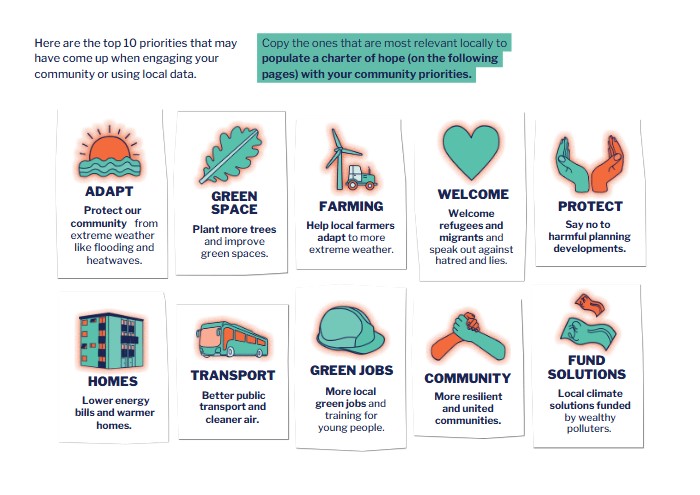
You can choose what your community wants this election from the priorities.
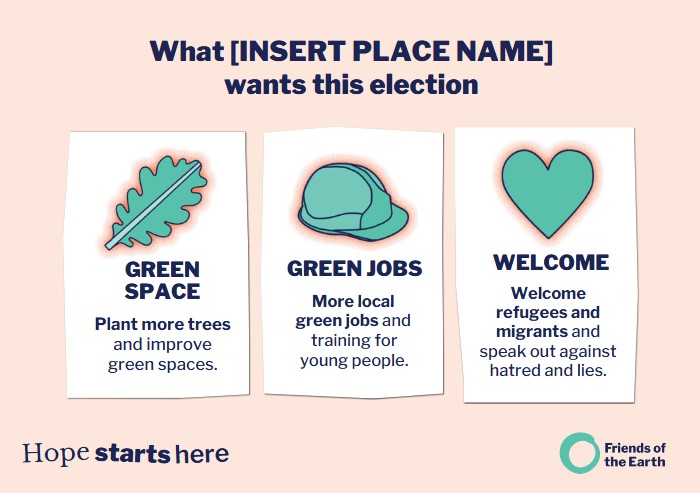
You’ll need to print your Charter for Hope so you can use it as a leaflet and a poster when sharing it locally. We’ve got a printing fund to help you do this. Email [email protected] to request support with printing costs up to £200.
How to share your charter for hope
You’ve listened to your community and created your Charter of Hope. Now it’s time to share it with your council and make sure local decision-makers hear what matters most to people.
Read our overarching guide, which includes guidance and templates for reaching out to your council to share your Charter for Hope.
Feedback to the community
Sharing what you heard is just as important as taking it to candidates. It shows respect for people’s time and builds trust. If you did a street survey or stall, consider going back to the same place to share what you heard and what you’re doing with it.
Around the community
Think about the key places you could put up a paper copy of your Charter of Hope for people to see. Here’s a few ideas to get you started:
- Community notice boards
- Community centres
- Food banks
- Cafes and shops
- Wholefood shops
- Places of worship
- Schools, colleges, universities
- Libraries
- Swimming pools and sports centres
- Local businesses
- Sports clubs and centres
You can maximise your reach, and ensure as many people as possible see your Charter of Hope by sharing it online to. That includes, making a video, sharing images of your charter, posting it on social media and engaging the local media.
Updating partners
Let local groups, faith organisations or community partners who helped know what came out of the listening and how it’s being used and invite them to engage their councillors alongside your group.
Resources
Here’s a summary of the resources available to help you with this stage of the campaign.
- Editable Charter of Hope - this is available in 3 sizes to allow printing of leaflets, posters and social media assets.
- Template social media posts to share your Charter of Hope.
- Support using Canva to create your charter of hope (email [email protected]).
- Template press release to share your Charter of Hope.
- A template email to send councillors to share your charter for hope.